

Manufacturers across plastics production environments face ongoing challenges with residue buildup that can compromise part quality and increase costly downtime. Contaminants such as release agents, plastic residue, oils, and other production byproducts can accumulate on molds and tooling surfaces, requiring effective and precise cleaning methods. Traditional approaches—including abrasive blasting, chemical cleaning, or water-based systems—may introduce surface wear, secondary waste, or unwanted moisture. As an alternative, release agent removal dry ice blasting offers a non-abrasive, dry solution. Equipment from Nu-Ice Blasting™ is designed to support industrial contaminant cleaning dry ice processes, enabling efficient plastic residue removal dry ice applications without damaging sensitive tooling or interrupting production conditions.
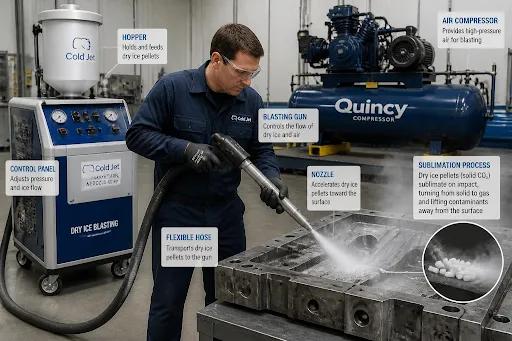
Dry ice blasting is an industrial cleaning method that uses solid carbon dioxide (CO₂) pellets accelerated by compressed air to remove contaminants from surfaces. The process involves directing dry ice pellets at high speed through a nozzle, where they impact the target area and break the bond between contaminants and the substrate. Upon contact, the pellets rapidly sublimate—transitioning from solid to gas—without leaving behind liquid residue. This characteristic eliminates secondary waste typically associated with water or chemical cleaning methods. As outlined by Nu-Ice Blasting™, the process provides a dry, non-abrasive approach suitable for sensitive equipment and production environments requiring controlled and residue-free cleaning conditions.
Kinetic Impact Dry ice pellets are propelled at high velocity using compressed air, creating a mechanical impact that helps dislodge surface contaminants. This force is sufficient to loosen residues without significantly affecting the underlying material.
Thermal Shock The extremely low temperature of dry ice introduces a rapid temperature change upon contact. This causes contaminants to contract and become brittle, weakening their bond to the surface and making removal more effective.
Sublimation Expansion When dry ice pellets strike the surface, they instantly convert from solid to gas. This rapid expansion lifts and separates contaminants from the substrate, contributing to a thorough cleaning process without leaving additional waste.
A dry ice blasting machine consists of several key components that work together to deliver consistent cleaning performance. An air compressor supplies the pressurized air needed to accelerate dry ice pellets through the system. The dry ice hopper stores and feeds the pellets into the machine, ensuring a steady supply during operation. A metering system regulates the flow rate of pellets, allowing operators to control cleaning intensity. The hose transports the compressed air and pellets from the machine to the nozzle, which directs the stream onto the target surface. Each component plays a specific role in maintaining controlled delivery and effective removal of contaminants.
Nu-Ice Blasting™ is a U.S.-based manufacturer of dry ice blasting equipment, with production centered on systems designed and built in the United States. The company focuses on engineering equipment that supports industrial cleaning applications across a range of sectors, including plastics manufacturing. Its product line is developed to enable processes such as industrial contaminant cleaning dry ice, providing a dry and controlled alternative to traditional cleaning approaches. By emphasizing equipment design and functionality, Nu-Ice Blasting™ supports applications where removal of residues must be achieved without introducing moisture or abrasive materials. The company’s approach reflects ongoing demand for reliable systems used in precision cleaning environments.
Nu-Ice Blasting™ equipment incorporates several functional components designed to support controlled dry ice blasting operations. The blasting gun serves as the primary interface for directing the flow of dry ice pellets and compressed air toward the target surface. Interchangeable nozzle options are available to adjust the spray pattern and velocity based on application requirements. Systems may also include integrated moisture separators, which help remove water vapor from the compressed air supply before it enters the machine. In addition, aftercoolers are used to reduce the temperature of compressed air, assisting in maintaining consistent operating conditions. These components work together to ensure stable delivery of dry ice media and compressed air throughout the cleaning process.
Nu-Ice Blasting™ equipment is designed with standardized technical parameters to support a range of industrial cleaning applications. Machine dimensions and overall weight vary depending on the configuration, allowing for both portable and stationary use. Hopper capacity is structured to hold a defined volume of dry ice pellets, enabling continuous operation for set periods. Air flow requirements are typically measured in cubic feet per minute (CFM), with systems designed to operate within a specified range to maintain effective pellet acceleration. Pressure ranges are also defined to regulate blasting intensity. Dry ice consumption rates are determined by the metering system and operating settings, allowing users to control the amount of media used during the cleaning process.
Preparation and Setup The process begins with connecting the dry ice blasting unit to a suitable air compressor and ensuring the system is properly assembled. Dry ice pellets are loaded into the hopper, and operating parameters such as air pressure and pellet feed rate are set.
Safety Requirements Operators are required to use appropriate personal protective equipment, including eye and hearing protection. Adequate ventilation is necessary due to the release of carbon dioxide gas during operation.
Typical Workflow Steps Once activated, compressed air propels dry ice pellets through the hose and nozzle toward the target surface. The operator directs the blasting stream across the area in a controlled manner, adjusting settings as needed throughout the cleaning process.
Nu-Ice Blasting™ equipment is utilized across a variety of industrial and commercial environments where controlled surface cleaning is required. In manufacturing and production settings, systems are used to maintain molds, tooling, and equipment surfaces during operational cycles. In food processing environments, dry ice blasting equipment is applied to cleaning tasks where dry, residue-free methods are necessary. The technology is also used in historical restoration projects, where delicate surfaces such as wood, stone, and metal require non-abrasive treatment. Additional applications include automotive and aerospace industries, where components and assemblies must be maintained without introducing moisture or abrasive materials. Electrical and specialty cleaning scenarios also incorporate dry ice blasting equipment for use on sensitive machinery and infrastructure.
Dry ice blasting is characterized by its ability to clean surfaces without generating secondary waste, as the dry ice pellets sublimate upon impact. The process is non-abrasive, allowing it to be used on sensitive materials without significant surface alteration. Because it is a dry method, it does not introduce moisture into the environment, and it operates without the use of chemical cleaning agents. These characteristics support industrial contaminant cleaning dry ice applications where controlled conditions are required. Operational considerations include proper ventilation to manage carbon dioxide levels and ensuring that equipment is used within specified air pressure and flow parameters for consistent performance.
Nu-Ice Blasting™ systems can be configured with a range of accessories to support different operational requirements. Nozzle options vary in design to adjust pellet flow patterns and accommodate specific surface geometries, while hose assemblies are constructed to handle the combined movement of compressed air and dry ice media. Integration with external air supply systems is essential, with compatible compressors, moisture separators, and aftercoolers used to regulate air quality and temperature. Storage considerations include maintaining dry ice pellets in appropriate insulated containers to minimize sublimation loss, along with routine equipment maintenance to ensure consistent system performance.
What happens during sublimation in dry ice blasting? During dry ice blasting, solid CO₂ pellets transition directly into gas upon impact. This phase change occurs instantly without becoming liquid, creating a rapid expansion that helps lift contaminants from surfaces while leaving no residual media behind.
Can dry ice blasting be used on sensitive equipment or electronics? Dry ice blasting is a dry cleaning method that does not introduce water or conductive residues. This allows it to be applied to electrical components and delicate surfaces where moisture or abrasive materials could interfere with functionality or surface integrity.
What are the air supply requirements for dry ice blasting systems? Dry ice blasting equipment operates using compressed air, typically requiring a consistent flow rate and pressure range to propel pellets effectively. Air quality is also important, with moisture separators and aftercoolers used to regulate temperature and remove excess humidity.
How should dry ice pellets be stored before use? Dry ice pellets are stored in insulated containers designed to slow sublimation. Because dry ice naturally converts to gas over time, proper storage conditions help maintain pellet integrity and ensure consistent feeding into the blasting system during operation.
What safety measures are required when operating dry ice blasting equipment? Operators are advised to use personal protective equipment such as eye and hearing protection. Adequate ventilation is necessary to manage carbon dioxide levels generated during sublimation, ensuring that gas does not accumulate in enclosed or poorly ventilated spaces.
How does dry ice blasting compare environmentally to abrasive cleaning methods? Dry ice blasting does not generate secondary waste because the pellets sublimate on impact. Unlike abrasive media, which must be collected and disposed of, this process reduces cleanup requirements and minimizes additional waste streams during industrial cleaning operations.
In which industries is dry ice blasting commonly applied? Dry ice blasting equipment is used across manufacturing, food processing, automotive, aerospace, and restoration sectors. It is applied where controlled cleaning is required without introducing moisture, chemicals, or abrasive materials to machinery, surfaces, or production environments.
Nu-Ice Blasting™ continues to support industrial cleaning operations through the development of dry ice blasting equipment engineered for controlled and consistent performance. With manufacturing based in the United States, the company maintains a focus on producing systems that align with the operational needs of industries requiring dry, non-abrasive cleaning methods. Its equipment is designed to integrate into existing workflows where compressed air systems and dry ice media are already utilized. As industries continue to evaluate alternatives to traditional cleaning methods, dry ice blasting remains a process grounded in established physical principles and adaptable to a range of applications involving sensitive surfaces and contamination control requirements.