

What this covers
|
The usual advice for working in a small room is to buy a smaller desk. It is the wrong first move, and it is why so many compact workspaces still feel unusable after the furniture arrives.
The constraint in a small room is almost never the footprint of the desk. It is the space behind it.
The Measurement Nobody Checks First
A desk requires clearance behind it for a chair to withdraw. That clearance is between 30 and 36 inches for an adult to push back, stand up and leave without turning sideways.
A desk 40 inches wide and 24 deep sounds modest. Put it against a wall in a room where the opposite wall is 60 inches away and there are 36 inches left, which works. Put the same desk in a room where a bed or a wardrobe reduces that gap to 20 inches and the room fails, regardless of how compact the desk is.
This is why shrinking the desk so often does not help. Going from 24 inches deep to 18 recovers six inches. Moving the desk to a wall where the clearance already exists recovers two feet.
The order of operations matters. Measure the clear route first, then choose the desk that fits what is left.
What a Desk Actually Has to Be Deep Enough to Hold
Depth is the dimension people compromise first and regret fastest. The requirement is set by equipment, not by taste.
What sits on it | Minimum depth | What goes wrong below it |
Laptop only | 18 inches | Nothing, if the screen is raised |
Laptop plus notebook | 20 inches | Paper ends up on the keyboard |
Single monitor | 24 inches | Screen sits too close, eye strain within a week |
Monitor on an arm | 20 inches | Arm needs a rear clamp point |
Dual monitors | 28 inches | Neck rotation increases across the day |
A laptop requires 18 inches of desk depth. A monitor requires 24 inches of desk depth to sit at a comfortable viewing distance, because the screen needs to be roughly an arm's length from the eye. A monitor arm changes that calculation, since it moves the screen backwards off the surface, and it is the single most effective way to make a shallow desk workable.
Below 18 inches a desk stops being a workstation and becomes a laptop shelf. That is a legitimate choice, but it should be a choice rather than a discovery made after delivery.
Standard Desk Height Was Sized for One Person
Standard desk height measures 29 to 30 inches. That convention suits an adult of roughly five foot ten sitting in a chair with an adjustable seat height.
Everyone else is compensating. Shorter users get shoulder elevation because the surface sits above a neutral elbow position. Taller users get a rounded back because the surface sits below it. In a large office this is absorbed by an adjustable chair and a footrest. In a small home office, where the chair is often a dining chair and there is no room for a footrest, it is absorbed by the body.
This is the strongest argument for height adjustment in a small space, and it is rarely the argument people hear. Adjustability is usually sold as a way to stand up. In a small room its more useful function is fitting one surface to a person the standard was not sized around, and to a second person if the room is shared.
Where Folding Desks Actually Fail
Folding designs solve the clearance problem completely, because the desk stops existing when it is folded. The failure mode is consistent enough to be worth stating plainly.
Folding desks fail at the hinge before the surface. The desktop outlives the mechanism, usually by years. What goes is the pivot, the locking pin or the catch that holds the leg square, and once there is play in that joint the desk wobbles under typing pressure and never stops.
That produces a simple buying rule. On a folding desk, the mechanism is the product and the surface is packaging. A heavier hinge on a plainer top will last longer than a beautiful top on a light frame.
Wall-mounted desks transfer load to wall anchors, which moves the failure point from the hinge to the wall. That is usually an improvement, provided the anchors go into studs rather than plasterboard. It also removes the option of moving the desk later, which matters more in rented accommodation than most buyers expect.
The Rooms That Work, and Why
Three layouts recur in small spaces because they solve clearance rather than footprint.
The corner. Corners are the least used space in almost any room and a corner desk converts dead area into a work surface without adding to the walking route. It usually yields more usable surface than a rectangular desk of the same footprint.
The alcove. Chimney breasts, wardrobes and stairs create recesses that are already unusable for furniture with a front. A desk in a recess borrows space nothing else wants.
The disappearing desk. Anything that folds, mounts or retracts returns its floor area to the room outside working hours. A desk that folds flat returns its floor space when not in use, which is the only approach that genuinely gives a room two functions rather than one function and a compromise.
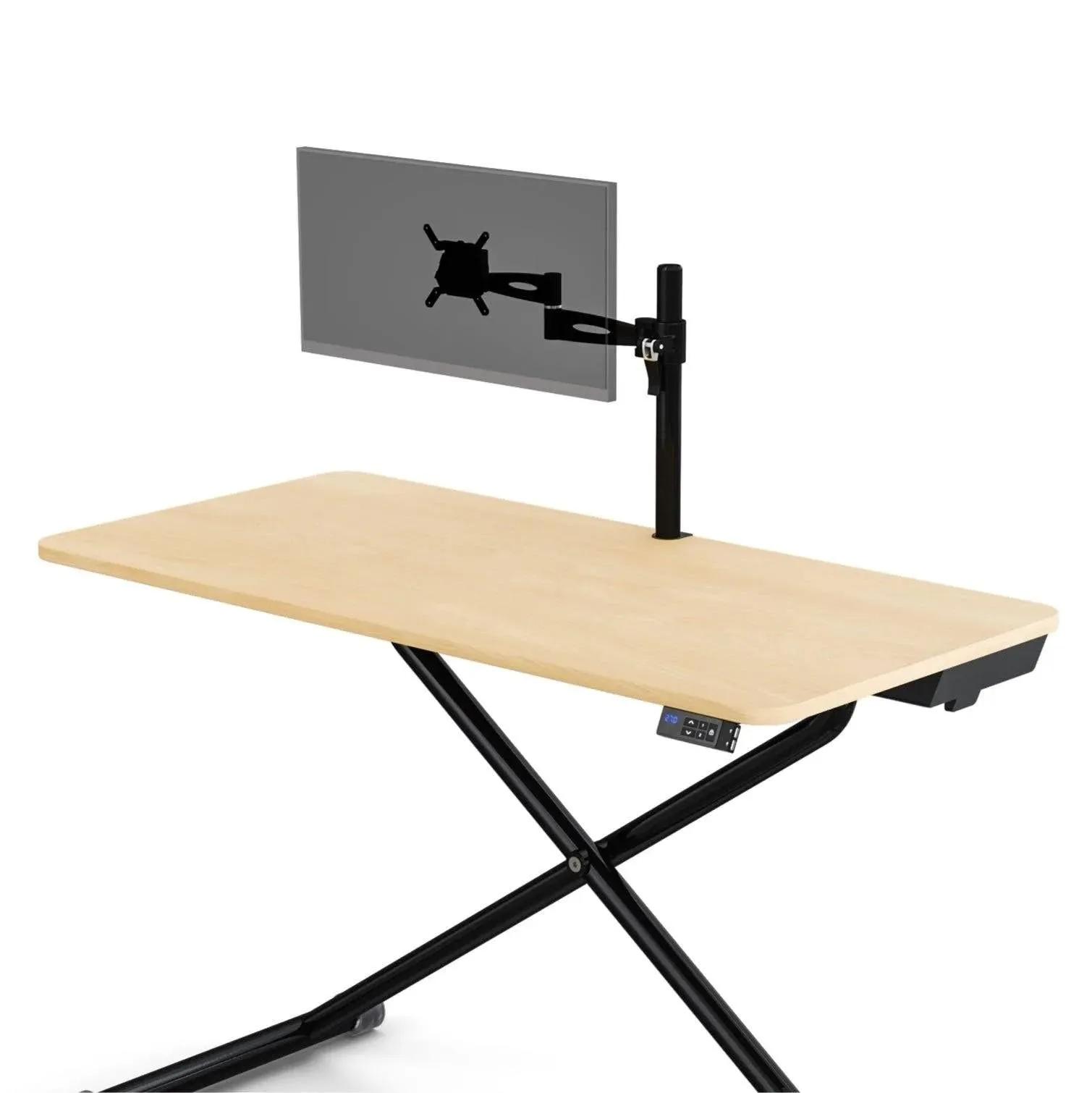
A fourth option is worth naming because it is under-used. A desk that adjusts from floor level upward lets a person work sitting on the floor, in a chair, or standing, which removes the chair from the equation entirely in the smallest rooms. The range of models covering that full travel is narrow, and a comparison of desks for small spaces is a reasonable starting point for anyone weighing it against a conventional compact desk.
What the Standard Advice Misses
Three things get left out of almost every small workspace guide.
Cable management is structural in a small room. In an office, loose cables are untidy. In a bedroom or studio the desk is visible from the bed or the sofa for the other sixteen hours of the day, so the cabling is a permanent feature of a room used for resting. A desk with a tray solves it. A desk without one needs a tray added, and the retrofit is always worse than the built-in.
Light matters more than in a large room. A small room usually has one window and one usable wall. Those are frequently not the same wall. Placing the desk for clearance and ignoring the light produces a workspace with a screen facing a window, which is a glare problem no monitor setting fixes.
Getting in and out needs planning. A desk pushed hard into a corner to save space can become one that requires a specific sequence of movements to leave. This sounds trivial and it is the reason people quietly stop using a workspace after a fortnight.
A Short Decision Path
For a room that has a second job in the evening, choose something that folds or mounts to the wall, and treat the mechanism as the thing you are buying.
For a room that is only ever a workspace, use the corner, and spend the budget on depth and height adjustment rather than on a smaller footprint.
For a shared room, height adjustment stops being optional, because one fixed surface cannot serve two people of different heights without one of them compensating with their shoulders or their spine.
And in every case, measure the clear route out before measuring anything else. The desk that fits the room is not the smallest one. It is the one that leaves the route intact.