

Photo: Pavel Danilyuk
There is a distinct kind of vulnerability that comes with getting sick in the middle of the night. Your world shrinks to the immediate discomfort you are feeling, but the solution our society has built requires you to do something incredibly disruptive. You have to put on shoes, navigate dark roads, and sit in a waiting room that feels entirely disconnected from the concept of comfort. We have accepted this routine for generations, not because it is a pleasant experience, but because we genuinely believed that high-level medical care could only exist inside a massive institutional building.
That belief is fading fast. A profound shift is happening in neighborhoods across the country as people begin to question why the patient always has to do the traveling. The modern world has re-engineered almost every other industry around human convenience, from how we buy groceries to how we work, yet healthcare has stubbornly insisted on maintaining its old geographic monopolies.
Today, people are demanding something different. They want emergency medicine that respects their boundaries, their time, and their natural desire to heal in a place they actually know and love.
Dismantling the Cost of the Hospital Default
When you unpack the sheer friction of a traditional emergency room visit, the most shocking element is often the financial aftermath. Anyone who has ever received a bill for a brief hospital stay knows the deep sense of confusion that follows. You look at the line items and wonder how a basic evaluation, some blood work, and a standard IV could possibly add up to thousands of dollars.
The secret lies in the architecture of the healthcare system itself. When you walk through those sliding glass doors, your bill is carrying the weight of the entire institution. You are paying for the brick and mortar, which becomes a financial burden passed directly to the consumer.
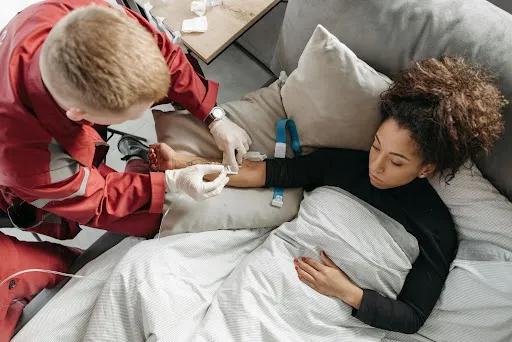
When you shift that exact same clinical episode to a living room, the financial reality changes completely. The massive overhead evaporates. A mobile medical team traveling with modern diagnostic tools can run blood work on the spot, administer medications, and check cardiac rhythms right on a patient’s couch at a mere fraction of the cost of a traditional hospital encounter. It exposes an unspoken truth of modern medicine. We do not need a multi-million-dollar building to safely treat a high-acuity illness; we just need the right expertise at the right moment.
The Cultural Push for True Sanctuary
This desire to bring emergency medicine home aligns perfectly with the broader cultural conversations taking place around us. Recent discussions have been focused heavily on the deep exhaustion within the medical workforce and the increasing strain on urban infrastructure. Cities are crowded, traffic is getting worse, and hospital systems are visibly stretched to their limits. In this environment, the idea of walking into a chaotic, overcrowded waiting room feels less like a path to recovery and more like an unnecessary risk.
People are realizing that comfort is not just a luxury or a matter of convenience; it is a fundamental component of healing. Lon Hecht, the CEO of Care2U, has pointed out that millions of individuals end up trapped in the stressful cycle of emergency room visits every year for conditions that could be managed perfectly well within their own four walls. It is a perspective that highlights the unnecessary stress we inflict on patients simply because of tradition.
When a medical professional steps into a home, the psychological dynamic flips entirely. The patient remains in control of their environment, surrounded by their own things and their own family. Their stress levels drop, their blood pressure stabilizes, and the clinician gets to see the patient as a whole person rather than just a chart number in a busy ward. Healing happens naturally when you are resting in your own bed instead of lying on a narrow gurney behind a thin fabric curtain.
Moving Beyond the Moving Parts
We are rapidly moving toward a future where the hospital will no longer be the default destination for every sudden medical crisis. The massive concrete complexes will always be vital for major surgeries, intensive trauma, and complex life-saving interventions, but they should no longer swallow up the millions of acute cases that just need timely, expert attention.
By shifting the boundary of emergency care back to the household, we are finally building a healthcare model that puts human dignity first. It is an approach that protects both the patient's wallet and their peace of mind, transforming medicine from a disruptive journey into a supportive, localized service. The era of waiting out the clock in a bright, noisy emergency room is coming to an end, and the future of healthcare is arriving exactly where it belongs, right at the front door.