

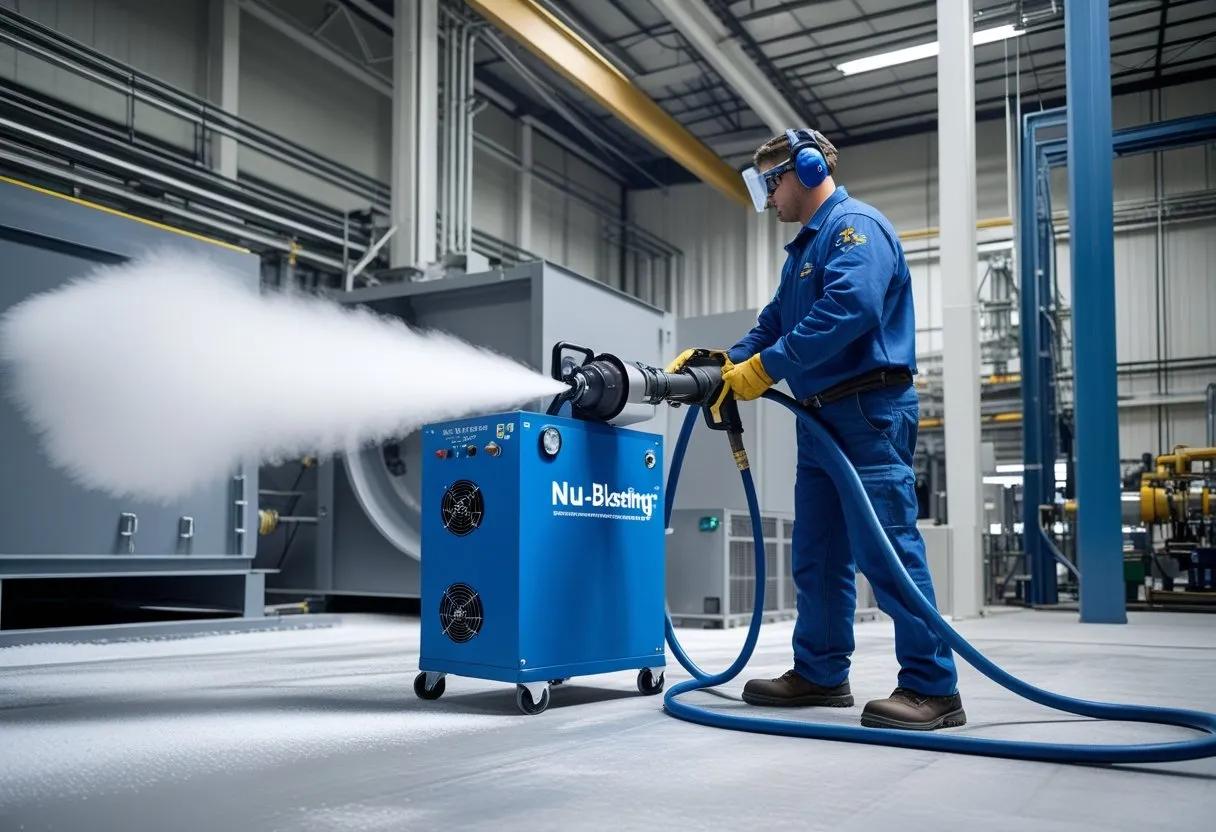
Industrial facilities across manufacturing, food processing, power generation, and automotive sectors face ongoing challenges from residue buildup, unplanned downtime, and the need to clean sensitive equipment without causing surface damage. Traditional abrasive, wet, or chemical cleaning methods can introduce secondary waste, extended shutdowns, or risk to delicate components. Nu-Ice Blasting™, an industrial dry ice blasting equipment manufacturer, provides systems designed to support non-abrasive, non-conductive, and residue-free cleaning processes using recycled CO₂ dry ice. As part of its structured media library, the company organizes technical videos, application demonstrations, and educational dry ice blasting media to help industry professionals better understand dry ice blasting as an alternative cleaning method.
Dry ice blasting is an industrial cleaning process that uses solid carbon dioxide (CO₂) pellets as the cleaning media. The pellets are accelerated in a stream of compressed air and directed at contaminated surfaces through a blasting nozzle. Upon impact, the dry ice pellets loosen surface contaminants. Because dry ice is solid CO₂, it sublimates upon contact—transitioning directly from solid to gas without becoming liquid. This phase change means the cleaning media does not leave behind additional moisture or secondary waste. The remaining material to be collected is the removed contaminant itself, making the process suitable for equipment and environments where residue control is important.
Kinetic Impact Dry ice pellets are propelled at high velocity using compressed air. When the pellets strike a surface, the mechanical force helps loosen and dislodge contaminants from the substrate.
Thermal Shock The low temperature of the dry ice creates a rapid temperature differential between the contaminant and the underlying surface. This temperature change can cause the contaminant to become brittle, weakening its bond.
Sublimation Expansion Upon impact, the dry ice pellets sublimate from solid to gas. The rapid expansion of CO₂ gas at the surface helps lift and separate the loosened material, supporting effective contaminant removal without introducing additional blasting residue.
A dry ice blasting machine consists of several integrated components that support consistent pellet delivery and airflow control.
Air Compressor – Supplies compressed air to propel the dry ice pellets through the system and toward the target surface.
Dry Ice Hopper – Holds the dry ice pellets prior to blasting and feeds them into the system.
Metering System – Regulates the flow rate of pellets into the airstream, helping maintain controlled cleaning output.
Hose and Nozzle – The hose transports the air and pellet mixture to the nozzle, where the stream is directed at the cleaning surface. Nozzle design influences distribution and application precision.
Nu-Ice Blasting™ is a U.S.-based manufacturer of industrial dry ice blasting equipment, founded in 1995. The company designs and manufactures its systems in the United States, supporting industrial cleaning applications across multiple sectors. Its equipment is engineered to use recycled CO₂ dry ice pellets as a cleaning medium, enabling non-abrasive and non-conductive surface treatment. As part of its organized dry ice blasting media resources, the company provides technical materials and visual documentation to support understanding of its systems and application methods. Over time, Nu-Ice Blasting™ has developed a range of machines intended for different industrial environments, maintaining a focus on equipment functionality, portability, and operational consistency rather than chemical or abrasive cleaning processes.
Nu-Ice Blasting™ systems include a blasting gun designed to deliver dry ice pellets through a controlled compressed air stream. The gun supports interchangeable nozzle options, allowing operators to adjust the delivery pattern based on application requirements and surface geometry.
The equipment also incorporates an integrated moisture separator and aftercooler system. The moisture separator is designed to remove water from the compressed air supply before it enters the blasting system, helping maintain consistent pellet flow. The aftercooler reduces the temperature of compressed air following compression, which supports stable air quality and system operation. Together, these components contribute to regulated airflow, pellet delivery control, and consistent performance across industrial cleaning environments.
Preparation and Setup Operation begins with positioning the equipment near the cleaning area and connecting it to an appropriate compressed air source. Dry ice pellets are loaded into the hopper, and airflow and pellet feed settings are adjusted according to the surface and contaminant type.
Safety Requirements Operators are required to use appropriate personal protective equipment (PPE), including eye and hearing protection. Adequate ventilation is necessary because the process releases CO₂ gas during sublimation. Standard industrial safety procedures apply during setup and operation.
Typical Workflow Steps Once the system is pressurized, the blasting gun is directed at the target surface. The operator controls pellet flow and air pressure through the metering system. After cleaning is complete, the system is depressurized and remaining dry ice is managed according to handling guidelines.
Nu-Ice Blasting™ equipment is used across a range of industrial and commercial environments where residue removal and surface preparation are required.
In manufacturing and production facilities, the systems are applied to machinery, molds, conveyors, and production lines. Equipment may be cleaned in place, reducing the need for disassembly in certain operational contexts.
Within food processing environments, dry ice blasting is used for cleaning processing equipment, packaging lines, ovens, and mixers. Because the process does not introduce water, it is suitable for areas where moisture control is necessary.
The technology is also utilized in historical restoration and on delicate surfaces where non-abrasive methods are required. Applications may include restoration of architectural elements, wood, or other sensitive materials.
Additional sectors include automotive, aerospace, and electrical industries. Equipment is used to address buildup on tooling, engines, composite surfaces, and electrical components, as well as in specialty cleaning scenarios requiring controlled, dry surface treatment.
Dry ice blasting operates without generating secondary blasting media waste, as the pellets sublimate from solid CO₂ directly into gas upon impact. The process is non-abrasive when properly configured, making it suitable for surfaces that require controlled interaction. Because no water or chemical solvents are introduced, it remains a dry, chemical-free cleaning method.
Environmental considerations include the use of recycled CO₂ and the need for adequate ventilation due to CO₂ gas release. Handling considerations involve proper storage of dry ice pellets and adherence to industrial safety practices. As outlined within the company’s organized media library, supporting dry ice blasting media resources provide operational guidance and technical context for industrial users.
Nu-Ice Blasting™ systems support interchangeable nozzle and hose configurations to accommodate varying surface geometries and access requirements. Nozzle selection influences pellet distribution and application precision, while hose length and flexibility allow operators to maneuver within industrial environments.
System integration includes connection to a suitable compressed air supply, along with the use of integrated moisture separators and aftercoolers to regulate air quality and temperature. Storage considerations involve maintaining dry ice pellets in appropriate insulated containers prior to use. Routine maintenance includes inspection of hoses, fittings, and air components to support consistent operation.
Frequently Asked Questions (FAQs)
What is dry ice blasting? Dry ice blasting is an industrial cleaning process that uses solid CO₂ pellets accelerated by compressed air to remove surface contaminants. Upon impact, the pellets sublimate directly into gas, leaving the removed material as the only remaining waste.
Is the equipment compatible with standard industrial air systems? Nu-Ice Blasting™ equipment operates using compressed air within specified flow and pressure ranges. Facilities must ensure their air supply meets these operational requirements for consistent pellet delivery and system performance.
What safety considerations apply during operation? Operators should wear appropriate personal protective equipment, including eye and hearing protection. Adequate ventilation is required because CO₂ gas is released during sublimation. Standard industrial safety practices apply during setup and use.
What infrastructure is required to operate the system? Operation requires a compressed air source with sufficient flow and pressure capacity, proper electrical access where applicable, ventilation for CO₂ management, and suitable dry ice storage prior to use.
How does dry ice blasting compare to abrasive cleaning methods? Unlike abrasive media, dry ice pellets sublimate upon impact and do not leave secondary blasting material. The process is designed to provide a non-abrasive interaction when configured correctly for the surface and contaminant type.
Does the process introduce moisture or chemicals? Dry ice blasting does not introduce water or chemical solvents during cleaning. The CO₂ pellets transition from solid to gas, supporting a dry process appropriate for environments where moisture control is necessary.
What are the environmental considerations? The process uses recycled CO₂ and does not generate additional blasting media waste. Facilities must ensure appropriate ventilation due to CO₂ gas release and manage removed contaminants according to standard environmental practices.
Founded in 1995, Nu-Ice Blasting™ continues to design and manufacture dry ice blasting equipment in the United States for industrial and commercial cleaning applications. The company’s systems are engineered to support non-abrasive, dry cleaning processes using recycled CO₂ pellets, with configurations intended for integration into existing facility air infrastructure. In addition to equipment manufacturing, Nu-Ice Blasting™ provides technical documentation, operational guidance, and application-based resources to assist users in understanding system setup and workflow considerations. Through its organized educational materials and demonstration content, the company maintains a structured approach to presenting information about dry ice blasting technology and its practical use across manufacturing, food processing, restoration, and specialty cleaning environments.